Every food and beverage business protects its recipe.
Ingredients are specified. Processes are documented. Quality is checked, batch after batch. Whether the business makes coffee, condiments, baked goods or bottled drinks, consistency in the product is treated as sacred.
But there is a second recipe, and it almost never gets the same care.
It determines how the brand looks on a shelf, explains an ingredient, introduces a product and adapts its story for consumers, retailers, distributors and foodservice partners. Call it the Second Recipe: the accumulated creative judgement that makes a brand recognisable.
Most companies guard the first recipe rigorously. The second is left to instinct.
And here is the uncomfortable truth: as the business grows, instinct stops being enough.
How does a founder's taste become a brand bottleneck at scale?

In the early years, the founder is the brand system. They taste the product, approve the label and review the website. They know whether a photograph makes the food look honest or artificial, which ingredient should lead the story, and which phrase simply does not sound like the brand.
Nobody writes this judgement down, because nobody needs to. The system walks the corridors.
Then the business grows. A packaging agency handles the new range. A social agency manages daily content. Distributors create regional material, retailers request adaptations, an export partner translates the story for another market.
Each contributor is capable. Each arrives at a sensible reading of the brief. The packaging agency emphasises shelf impact, the performance team emphasises conversion, the retailer emphasises price.
None of them is wrong. But the customer meets every version, often in the same week, and what should feel like one confident brand starts to feel like several companies sharing a logo.
This is the Founder Ceiling: the point at which the very judgement that built the brand becomes its bottleneck. More work comes back almost right. Approvals queue behind one palate. Growth has turned taste into a queue.
Why does F&B face a scale problem no other industry matches?

F&B carries two burdens most categories never face together.
The first is variation. A new product rarely has one launch. It needs packaging and its format variations, ecommerce imagery, retailer listings, social content, trade presentations and foodservice sheets, and if it crosses borders, each of those needs localising. The product story must become a shelf story, the shelf story an ecommerce story, the ecommerce story a social story, each carrying a different emphasis while preserving the same character. The original thinking takes a day. Its distribution can take weeks.
Ask any F&B leader how much of the creative team's week goes to developing new ideas versus adapting approved ones. The answer says more about the growth ceiling than the marketing budget does.
The second burden is governance. Nearly every claim on every asset is regulated, and the rules shift between markets: nine declared allergens in the United States, fourteen in the UK and EU, and words like "natural", "organic" and "supports immunity" carrying legal weight everywhere. Claims travel into listings, menus, banners and captions, and when those assets are created independently, approved language changes through small, well-meaning edits. A shortened sentence here, a retailer's headline request there. Each change looks minor. Together they accumulate into risk, and every rushed edit becomes a compliance exposure as well as a brand one.
Velocity, character and compliance. The current way of working forces a choice of two. Growing brands need all three.
Why generic AI makes it worse

The obvious shortcut is the one everyone has tried: generic AI for copy, images and layouts.
The results are predictable. Ask a generic tool to introduce a new snack or beverage and you get competent category language: carefully selected ingredients, irresistible flavour, moments of joy. Smooth, appealing, and interchangeable with dozens of other companies.
The imagery has the same problem. Polished, abundant, beautifully lit, and curiously empty. Food photography lives on texture, light and honesty: the open crumb of real bread, the condensation on a real bottle, the imperfect drip that says a person made this. Generic generation defaults to the category's plastic average, and for a brand whose promise is realness, the average is poison.
The problem was never that AI writes badly. It is that it knows food in general and nothing about your brand in particular. And prompts cannot fix this, because a prompt depends on who writes it and what they remember. Two people using the same tool produce two different brands. The fragmentation problem simply moves inside the AI workflow.
What Euryka does differently
Euryka starts from the opposite end: capture how the brand thinks before scaling how the brand creates.
We call the foundation Shared Context: your brand's character, product truths, audience registers and approved claims, held once as living context and enforced everywhere. From it, every audience gets its own register of one unmistakable voice, every visual carries your real-texture honesty rather than the category's gloss, and every launch moves through one workflow, reviewed once, live together, with compliance guiding the work early rather than catching it late.

The outcome is not more content. It is Creative Continuity: judgement travelling with the work instead of being rebuilt for every asset. How the five parts of the platform deliver this, from Brand Hub through to Euryka Studio, and what it changes for a founder-led producer, a scaling brand and a global operator, is laid out properly in the paper.
The full argument
This post is the short version.
The long version examines the Founder Ceiling in detail, where the weeks of every product launch actually go, the regulatory layer that turns creativity into governance, why generic AI accelerates sameness, and how Shared Context is built in practice.
If you run a food or beverage business and any of this feels familiar, it is worth ten minutes of your time.
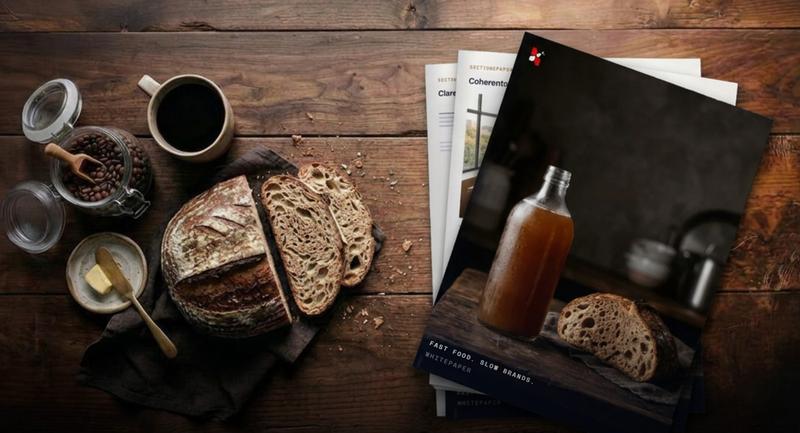
Read the full paper: Fast Food. Slow Brands.